Outdoor Kitchen Cabinets
Planning Outdoor Kitchen Cabinets for Holiday Hosting in Central Florida
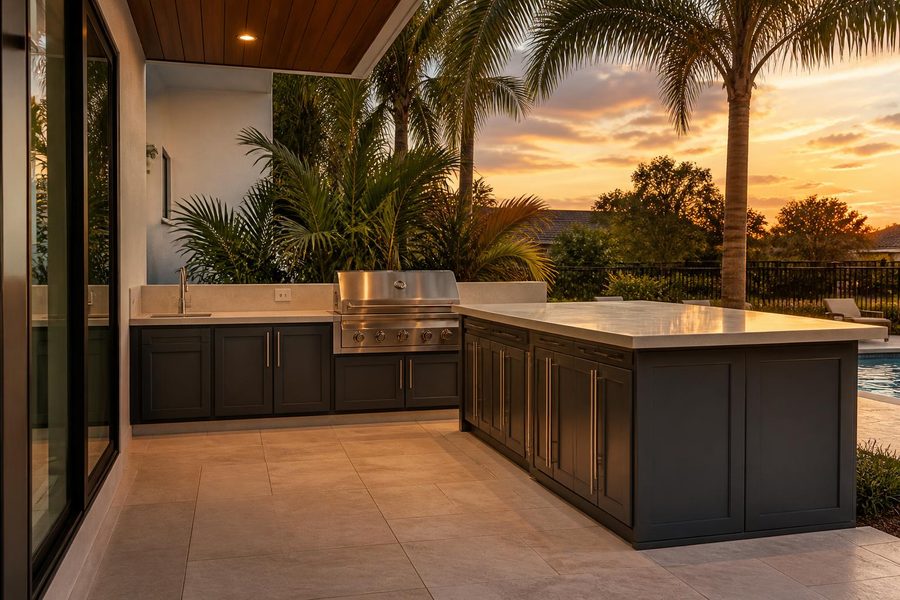
Outdoor kitchen cabinets holiday hosting guide for Central Florida: storage, serving counter space, and traffic flow tips.


Most outdoor kitchen conversations focus on cabinet doors, drawers, and countertops, but the base of the cabinet — specifically the toe-kick, the recessed section at floor level — plays a bigger role than it gets credit for. It affects how comfortable it feels to stand at the counter, and on an Orlando patio, it also affects how the cabinet handles water at ground level.

The toe-kick is the small recessed gap at the bottom front of a cabinet, set back from the main cabinet face. Its original purpose is ergonomic: it lets you stand close to the counter to work without your feet hitting the cabinet base, which keeps your posture upright instead of leaning forward to reach the surface.
Without a toe-kick, or with one that is too shallow, standing at the counter for any length of time — prepping food, working at the grill, mixing drinks at a beverage station — becomes noticeably less comfortable, since there is nowhere for your feet to go except directly under the cabinet edge.
Indoors, toe-kick height is mostly a comfort question. Outdoors, especially on an Orlando patio, it is also a practical one. Orlando’s heavy seasonal rain means outdoor kitchen cabinets need a base design that keeps water from pooling directly against the cabinet at floor level. For the wider layout picture, we cover how we plan cabinet runs around Orlando patios, pool decks, and covered lanais on our Orlando outdoor kitchen cabinets page.
A well-designed base sits the cabinet slightly elevated off the patio surface, with a toe-kick that allows water to flow past rather than collecting in a tight gap against the material. This matters for any outdoor cabinet material, but it is a particularly important detail to confirm when comparing cabinet lines, since base designs vary more than most buyers expect.
Toe-kick height also plays a role in day-to-day comfort that is easy to underestimate until you are actually standing at the counter. A shallow or missing toe-kick forces you to lean forward slightly to reach the work surface, which can become noticeably tiring during longer cooking sessions, food prep for a gathering, or extended time at a beverage station. A properly proportioned toe-kick lets you stand naturally close to the counter, which is a small detail that has an outsized effect on how comfortable the outdoor kitchen feels to use regularly.

Marine-grade polymer cabinetry is built specifically for wet, humid, sun-exposed environments, which makes base design part of the material’s overall value in an Orlando setting. Because the material itself resists moisture damage, a properly designed base and toe-kick can handle routine rain exposure and splashback without the swelling, staining, or rot risk that can affect other outdoor cabinet materials over time.
This is one reason base design is worth asking about directly when comparing cabinet options: a durable material paired with a base that traps water against it defeats some of the material’s own advantage. Confirming how a specific cabinet line handles ground-level water exposure is a reasonable question to bring to a Casual Kitchens Outdoor Cabinets consultation.
Reviewing finished layouts in the outdoor cabinet gallery can also give a sense of how base and toe-kick details look once a cabinet run is installed on a real Orlando patio.
A few base-related questions are worth confirming before finalizing an outdoor kitchen cabinet order:
Browsing available cabinet modules ahead of a consultation can help you compare base and toe-kick details across different cabinet styles before deciding on a final layout.

Toe-kick and base design do not exist in isolation — they interact with several other parts of an outdoor kitchen installation. Understanding how these pieces fit together can help you ask better questions during planning:
Raising these points during your initial planning conversation, rather than after cabinets are installed, gives Casual Kitchens Outdoor Cabinets the chance to match the base design to your specific patio conditions from the start.
It is also worth walking your patio at different times — right after a heavy rain, and again once it has dried — to see where water tends to sit longest. Sharing those observations during a planning conversation gives a clearer picture than a single dry-day site visit alone, and it can help identify whether a particular section of the cabinet run needs extra attention to base height or drainage clearance compared to the rest of the layout.
A toe-kick is the recessed section at the base of a cabinet, set back from the front face, that lets you stand close to the counter without your feet hitting the cabinet. It improves standing comfort and is a standard feature on most quality cabinet designs.
Orlando’s frequent heavy rain means an outdoor cabinet base needs to handle water at ground level without trapping it against the material. A well-designed toe-kick and base help water flow past the cabinet rather than pooling directly against it.
Yes. An uneven or sloped patio can change how consistently the toe-kick gap sits relative to the ground across a full cabinet run, which is worth discussing with your cabinet supplier alongside any separate leveling work needed for the installation.
No. Base and toe-kick details vary between cabinet lines and materials. It is worth confirming how a specific cabinet’s base handles ground-level water exposure, especially for an uncovered patio or pool deck area.
Ready to plan your next outdoor kitchen cabinet decision? Contact Casual Kitchens Outdoor Cabinets at (407) 887-0035 or request a consultation through our contact page to talk through your layout, materials, and cabinet configuration options.
Outdoor kitchen cabinets holiday hosting guide for Central Florida: storage, serving counter space, and traffic flow tips.
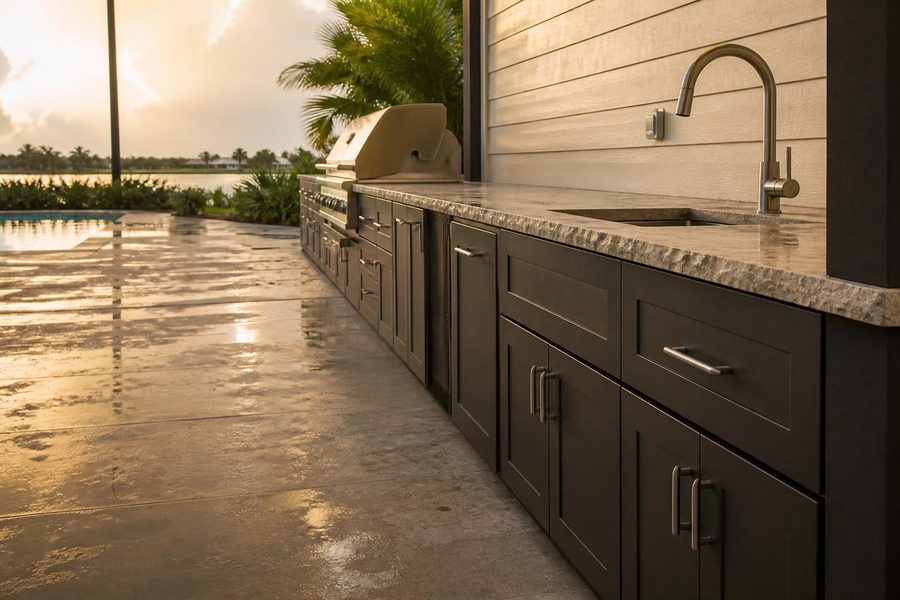
Outdoor kitchen cabinet drainage planning: learn how patio slope, raised bases, and runoff keep outdoor kitchen cabinets dry and long-lasting in Central Florida rain.
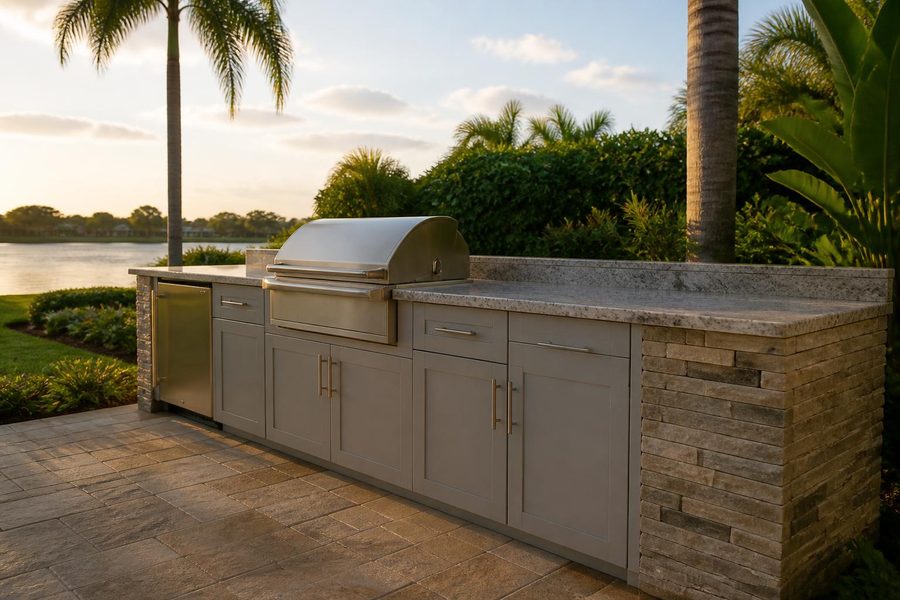
Outdoor kitchen cabinets Lake Mary homeowners can plan around: lanai, patio, and lakeside layouts with humidity and material tips.